

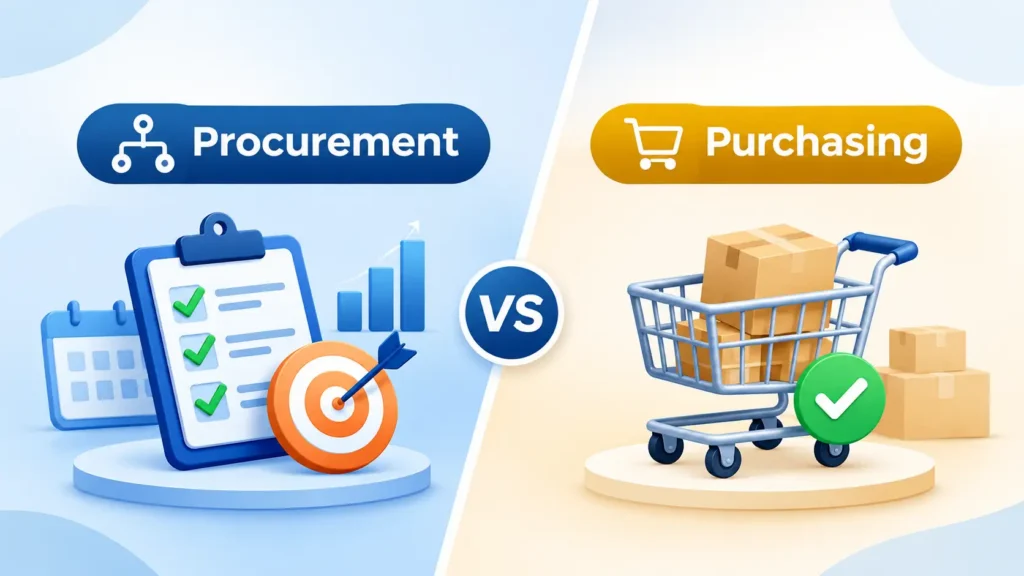
Procurement vs purchasing is one of the most common points of confusion in business operations, and mixing up the two can quietly cost a company time, money, and control. Many teams use the words as if they mean the same thing. They do not. Purchasing is the act of buying. Procurement is the full process behind that purchase, from identifying a need to paying the supplier and reviewing how the supplier performed.
In this guide, you will learn the clear difference, see a side-by-side comparison, find out when a growing business needs structured procurement, and see how a procurement solution like BizTRAQ brings every step together in one platform.
Procurement vs Purchasing at a Glance
Quick answer: purchasing is the transaction, and procurement is the strategy. Purchasing is one step inside procurement.
Purchasing focuses on ordering goods or services at the right price and time. Procurement covers the whole journey: sourcing suppliers, approving requests, issuing purchase orders, receiving deliveries, matching invoices, paying vendors, and managing supplier relationships over time.
What Is Procurement?
Procurement is the end-to-end process of sourcing, buying, receiving, and managing the goods and services a business needs to operate. It starts long before an order is placed and continues after the delivery arrives.
A complete procurement process usually includes:
- Identifying purchasing needs
- Researching and selecting suppliers
- Approving purchase requests
- Issuing purchase orders
- Receiving goods and services
- Verifying and matching invoices
- Processing payments
- Reporting on spend and supplier performance
Modern procurement is not only about finding the lowest price. It supports strategic sourcing, supplier relationship management, procurement compliance, spend management, and cost optimization. In any discussion of procurement vs purchasing, procurement is the wider and more strategic side.
What Is Purchasing?
Purchasing is the transactional part of buying. Once a business knows what it needs and who it will buy from, purchasing handles the order: raising a purchase requisition, confirming the price, creating a purchase order, and arranging delivery.
Here is a simple example. An office manager needs 20 laptops for a new team. Purchasing is placing the order with an approved supplier at the agreed price. Procurement is everything around that order: defining the specifications, comparing suppliers, getting budget approval, tracking the delivery, matching the invoice, and reviewing the supplier afterward.
Purchasing is fast, repeatable, and task-focused. That is why the procurement vs purchasing question is really about scope and strategy, not just vocabulary.
Key Differences: Procurement vs Purchasing
The table below shows how the two compare side by side.
| Factor | Purchasing | Procurement |
|---|---|---|
| Scope | The buying transaction | End-to-end, from sourcing to payment |
| Goal | Get the item at the right price and time | Create long-term value, control cost, and reduce risk |
| Focus | Order processing | Strategy, compliance, and supplier relationships |
| Process | Requisition, purchase order, delivery | Sourcing, approval, PO, receiving, invoice matching, payment, reporting |
| Supplier relationship | Transactional | Long-term and performance-managed |
| Cost approach | Lowest price per order | Total cost and overall spend control |
| Outcome | Order completed | Better visibility, savings, and supplier performance |
In short, purchasing is operational, while procurement is strategic.
The Key Differences Explained
Scope. Purchasing covers a single event: the moment a business places an order and receives what it asked for. Procurement covers the full cycle, from spotting a need and sourcing suppliers through approvals, receiving, invoice matching, and payment.
Goal. The goal of purchasing is to get the right item, at the right price, at the right time. Procurement aims higher: to create long-term value, control spending across departments, and reduce supplier and compliance risk.
Focus. Purchasing teams focus on keeping orders moving. Procurement teams focus on the bigger picture, including approval rules, compliance, supplier performance, and how much the business spends overall.
Process. Purchasing follows a short, repeatable path: requisition, purchase order, delivery. Procurement wraps additional stages around that path, such as supplier selection, goods receipt, invoice verification, and reporting.
Supplier relationship. In purchasing, a supplier is often just the source of the next order. In procurement, suppliers are evaluated, tracked, and developed over time, which leads to better pricing, terms, and reliability.
Cost approach. Purchasing looks for the lowest price on each order. Procurement looks at the total cost, including the delivery delays, quality issues, rework, and payment errors that a low price can hide.
Outcome. Purchasing ends when the order is complete. Procurement ends with clearer business information, stronger audit readiness, and measurable savings the business can build on.
Is Purchasing Part of Procurement?
Yes. Purchasing is one step within the broader procurement process. Procurement includes sourcing, negotiation, approvals, ordering, receiving, invoice verification, and payment, while purchasing covers the ordering step in the middle. Every purchase is part of procurement, but procurement is much more than purchasing. That is the simplest way to remember procurement vs purchasing.
What Is the Main Difference Between Procurement and Purchasing?
The main difference is scope. Purchasing answers the question, “What do we buy, and when?” Procurement answers a bigger set of questions: what do we need, who is the best supplier, how do we control the cost, and how do we manage that relationship over time? Purchasing handles the transaction. Procurement manages the strategy behind it.
Procurement vs Purchasing Process: Step by Step
A simple purchasing process usually follows four steps:
- Receive a purchase requisition
- Confirm the supplier and price
- Issue a purchase order
- Arrange delivery
A full procurement process includes those steps and adds the strategic and financial stages around them:
- Purchase requisition submission
- Procurement approval workflow
- Supplier selection
- Purchase order generation
- Delivery and goods receipt
- Invoice matching and verification
- Payment processing
- Procurement reporting and analysis
Notice where purchasing sits: in the middle, as one part of the cycle. Everything before it protects the budget and the choice of supplier. Everything after it protects accuracy, accountability, and payment control.
Is a Purchase Order Part of Procurement or Purchasing?
Both. A purchase order is created at the purchasing stage, but it belongs to the larger procurement lifecycle. In a structured process, the purchase order is generated from an approved requisition, then matched against the delivery and the supplier’s invoice before payment is released. That matching step is what stops businesses from paying for items they never received or paying the wrong amount.
Why the Difference Matters for Your Business
Understanding procurement vs purchasing helps business leaders see exactly where money, time, and control are being lost. When a company treats buying as a simple transaction, problems tend to appear:
- Poor visibility: purchase requests, orders, and invoices sit in different spreadsheets and inboxes.
- Slow approvals: manual approval chains delay decisions and disrupt operations.
- Budget overruns: without spending controls, costs grow unnoticed until the end of the month.
- Weak vendor management: supplier performance, pricing, and contracts are hard to track.
- Compliance gaps: there is no clear audit trail showing who approved what.
A procurement approach solves these problems by adding structure, accountability, and clear business information at every stage.
Procurement vs Purchasing: Which Does Your Business Need?
A small team that places a handful of orders each month can often manage with basic purchasing. As the business grows, more departments, suppliers, and budgets come into play, and purchasing alone stops being enough.
When Should a Business Move From Purchasing to Procurement Management?
It is usually time to adopt structured procurement management when:
- Approvals take days because requests move through email chains
- Departments overspend, and nobody notices until the budget is gone
- Nobody has one clear view of open orders and deliveries
- Supplier details and performance live in scattered files
- Invoices do not match purchase orders, and audits become stressful
If two or more of these sound familiar, a procurement solution will likely save more time and money than it costs.
How a Procurement Solution Brings Both Together
A procurement solution connects the buying step to everything around it, so teams no longer manage requests, orders, vendors, and budgets in separate places. In one platform, businesses can run approval workflows, generate purchase orders from approved requests, manage vendors, track deliveries, and monitor budgets in real time.
This gives purchasing teams speed and gives finance and leadership control. BizTRAQ is built for exactly this: its procurement management solution brings the transactional and strategic sides of buying into a single workflow.
What Is BizTRAQ?
BizTRAQ is an AI-powered business information platform developed by Triulta. It brings the core business solutions a company relies on into one place: CRM, HR management, asset management, procurement management, and contract management. Instead of running separate, disconnected tools, teams work from the same business information, which improves visibility, speeds up decisions, and reduces manual work.
How BizTRAQ Helps With Procurement Management for Business Solutions
BizTRAQ closes the gap between procurement vs purchasing by connecting the order itself to every step around it. Its procurement management solution supports the full purchase-to-pay cycle in one centralized platform.
Purchase Requisition and Approval
Employees submit requisitions, and approvers review and authorize them through structured, multi-level approval workflows. The result is faster approvals, standardized purchasing, and a complete audit history.
Smart PO Generation
Approved requisitions convert into purchase orders automatically. This reduces manual entry, improves accuracy, and speeds up purchasing across the organization.
Centralized Vendor Management
Vendor profiles, pricing, contracts, and communication records stay in one place. Teams can evaluate suppliers more easily and build stronger vendor relationships.
Delivery and Order Tracking
Teams follow orders and deliveries from start to finish, with real-time visibility into progress and delivery timelines.
Invoice Matching and Documentation
Invoices are matched against purchase orders and delivery records before payment, which reduces discrepancies and keeps the business audit-ready.
Budget and Cost Control
Spending is tracked in real time against allocated budgets, so overspending is caught early instead of at month end.
Together, these capabilities turn buying into a controlled, transparent procurement process, whether you run a small procurement team or complex enterprise purchasing.
Other BizTRAQ Products That Work Alongside Procurement
Procurement rarely works alone. BizTRAQ offers connected solutions so every team shares the same business information:
- CRM: manage leads, customers, and your sales pipeline in one place, so sales and service teams work from one shared view of every customer.
- HR Management: organize employee information and core HR processes on the same platform, so people operations stay structured as your team grows.
- Asset Management: track company assets across their lifecycle, from the moment they are purchased to maintenance and retirement.
- Procurement Management: automate purchase requests, approvals, purchase orders, vendor management, and invoice matching, as described above.
- Contract Management: create, store, and track contracts, and link purchase orders with contracts for stronger financial control.
For workflows that do not fit a standard solution, BizTRAQ also offers a Build Your Own option.
Conclusion
The procurement vs purchasing question comes down to scope. Purchasing is the transaction of buying, while procurement is the complete process of sourcing, approving, ordering, receiving, paying, and managing suppliers. Every business buys, but only businesses with structured procurement gain real control over cost, speed, and supplier performance.
Ready to move beyond spreadsheets and manual approvals? Explore BizTRAQ’s procurement solution or request a demo to see how one platform can streamline your entire procurement process.
